Portfolio basics
How to create the best portfolio online: a guide for UK and Irish university students
For students at Oxford, UCL, Edinburgh, Trinity College Dublin and other UK and Irish universities: build a portfolio for placements and graduate jobs.
By Numan Qamar, Founder, Folitox AI · · 4 min read
If you study at Oxford, Cambridge, Imperial, UCL, LSE, King's College London, Edinburgh, Manchester, Warwick, Bristol, Durham, Glasgow, Leeds, Trinity College Dublin, University College Dublin, the University of Galway, University College Cork, DCU, TU Dublin or any other university in the UK or Ireland, the job market has a few habits of its own. This guide covers what is different and how a portfolio fits in.
Know the calendar
Many large UK and Irish employers run graduate schemes and internship programmes with application windows that open early, often in the autumn for roles starting the next year. Some close when enough applications arrive. If you wait until spring to prepare, you may miss the first rounds.
Build your portfolio before the autumn of your penultimate or final year, so the link is ready when the first forms open. If your degree has a placement year or sandwich year, treat the application for that as the first target.
The UK and Irish CV convention
The standard CV in the UK and Ireland is short, usually one or two pages, and leaves out a photo, date of birth, marital status and similar personal details. Employers want to assess you on skills and evidence.
Follow the same approach on your portfolio. Leave out your date of birth and home address. A professional photo is optional. If you include one, keep it simple. See personal information on your portfolio and choosing a profile photo.
Placements, internships and societies
British and Irish students often have material that other countries' students don't: a placement year, a summer internship, a year in industry, society committee roles or volunteering through the students' union. Employers value these, so give them space:
- Describe what you did in a placement in two or three factual lines, not just the company name.
- If you held a committee role, such as treasurer or events lead, say what you organised and what happened.
- Show your final-year dissertation or project with a plain-language summary, then link to the full text if it's public.
Explaining your degree
UK degrees are classified, for example 2:1 or first-class honours. Irish degrees use similar classifications. Employers abroad may not know them. Put the classification in your education section as you'd write it at home. If you apply abroad, add a short note, such as "UK upper second-class honours (2:1)". If you haven't graduated yet, write "expected" with the year.
Choose three to five projects
Pick the work that matches the role you want, where you did a real share of the work and can explain it in two minutes. Dissertations, group projects, hackathons, society projects and placement work all count. Use this structure for each one:
- The problem and who it was for
- Your role
- One or two decisions you made, and why
- The result, with real numbers only if you have them
- What you learned
See how to write a case study and quantifying your achievements.
Right to work
If you are an international student, employers will want to know whether you can work in the UK or Ireland. Rules change and depend on your visa, so check the official government site and your university's international office. On your portfolio, keep any statement short and factual. Don't guess. See portfolios for international job applications.
Use your careers service
Almost every UK and Irish university has a careers service that reviews CVs and applications, runs employer events and can book mock interviews. Ask them to look at your portfolio as well. It's free and often underused.
Publish and share it
Folitox AI can read your CV and draft a portfolio website for you, with your bio, projects, skills and education. You choose a template, fix anything that's wrong, add your images and links, and publish at your own address. It is free to start. Then add the link to:
- The top of your CV
- Your LinkedIn profile, in the Featured and About sections
- Your GitHub profile README, if you write code
- Applications for graduate schemes, placements and internships
- Your email signature
See where to share your portfolio and your portfolio and LinkedIn profile.
By subject
- Computer science and engineering: projects, code and your dissertation. See the software developer portfolio guide and the engineering portfolio guide.
- Business, economics and finance: case studies, society work and internships. See the marketing portfolio guide.
- Architecture and design: process and a few strong pieces. See the architect portfolio guide and the designer portfolio guide.
- Humanities, law and sciences: writing samples, research and projects. See the writer portfolio guide and the researcher and academic portfolio guide.
Quick checklist
- Application dates noted, portfolio ready before they open
- No date of birth or home address
- Placement, society and dissertation work described clearly
- Degree classification written the way employers expect
- Three to five projects with problem, role and result
- Link on your CV, LinkedIn and applications
Putting it together
UK and Irish employers often move early and read quickly. A portfolio that is ready before applications open, with clear projects and no unnecessary personal details, helps you stand out. Use your careers service, and share the link wherever you share your CV.
Portfolio templates for Education & Teaching
These are Folitox templates designed for education & teaching portfolios, shown with sample content. Every one is filled in from your CV, and you can switch between them at any time.
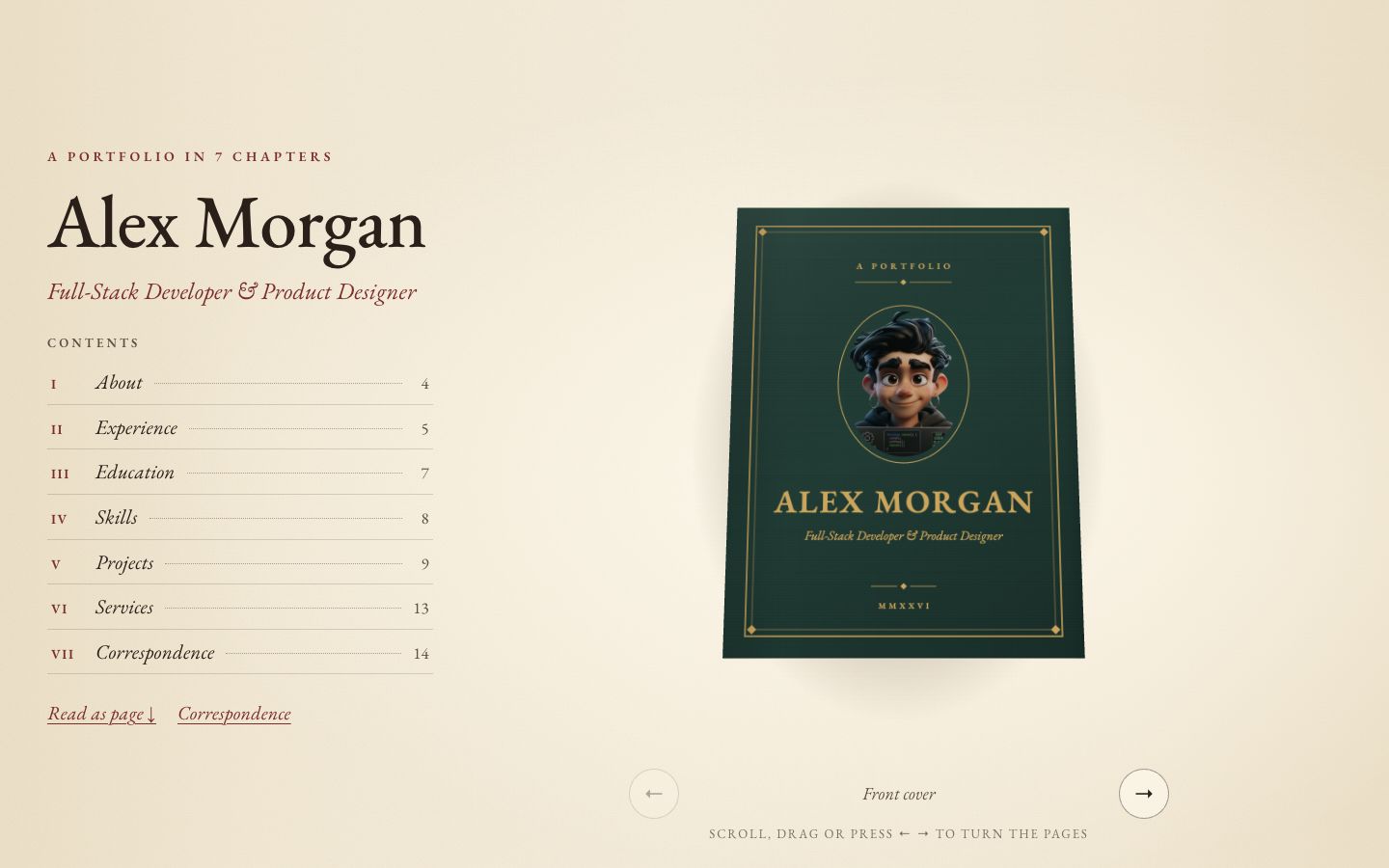
Chapter
Your story as a 3D hardcover on warm paper — scroll to turn curling pages, with a full reading view and letter-style contact form.
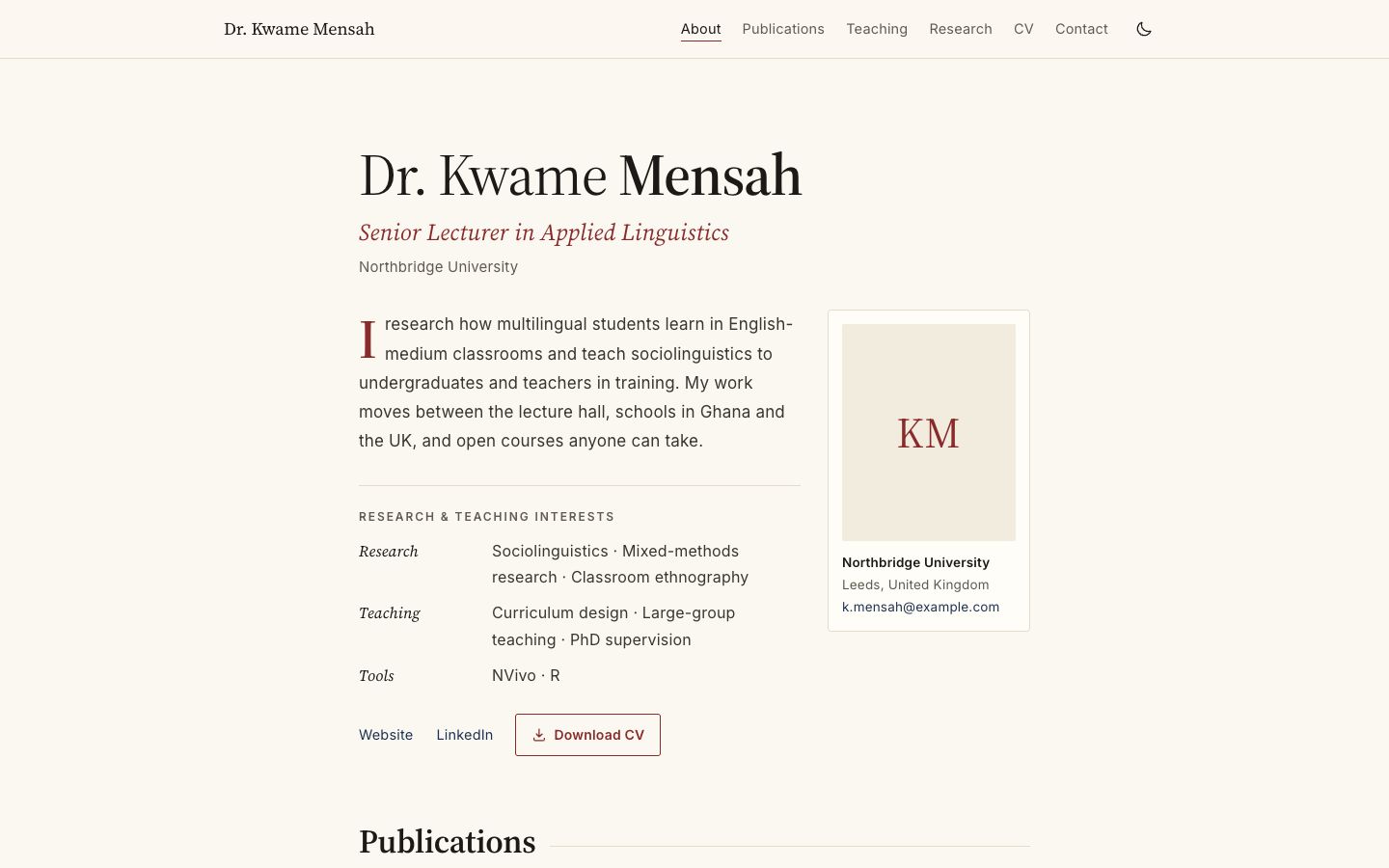
Academica
Scholarly single column: publications by year, teaching table, grants and talks.
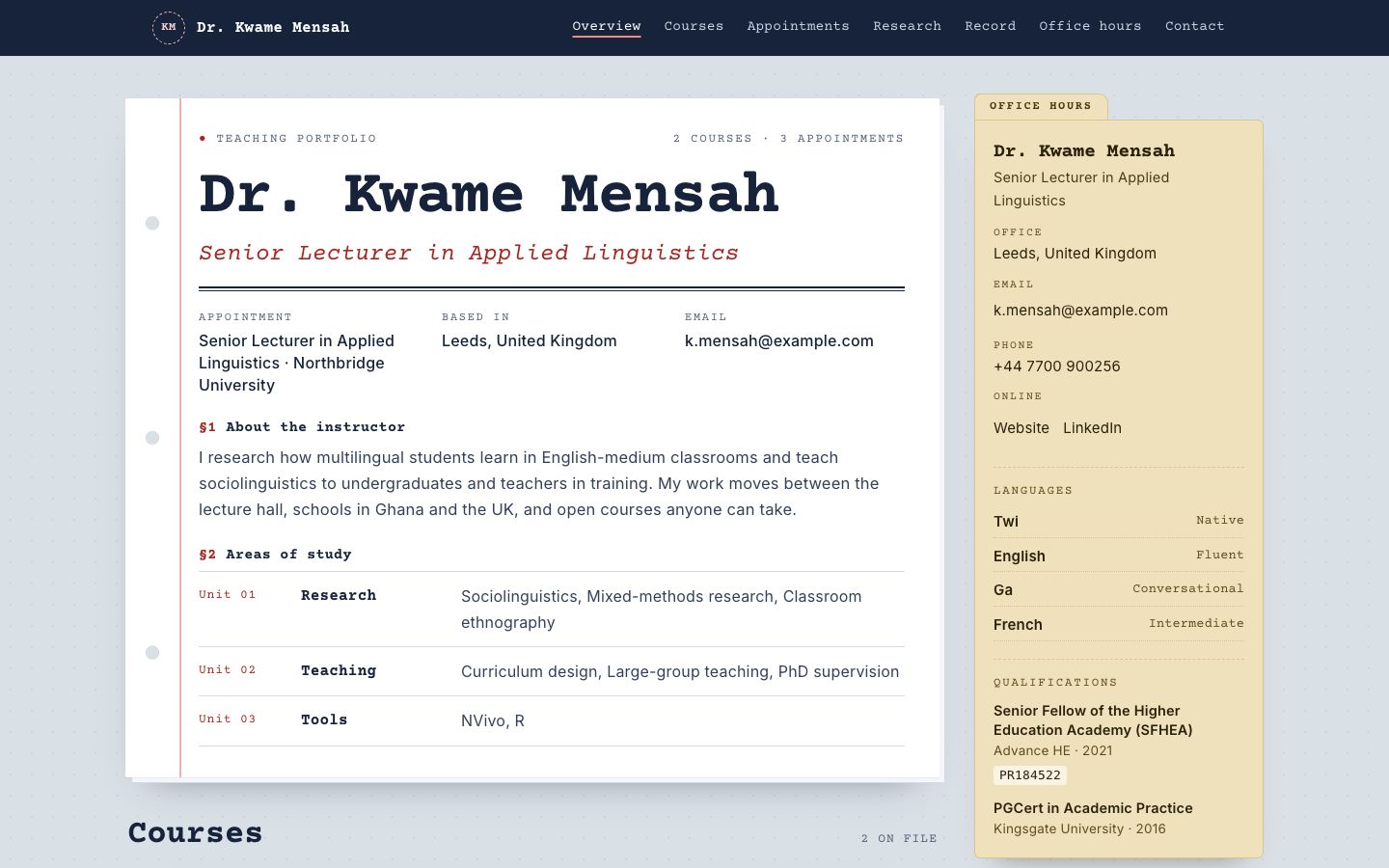
Syllabus
Courses as printed syllabus cards, with an office-hours sidebar and reading list.
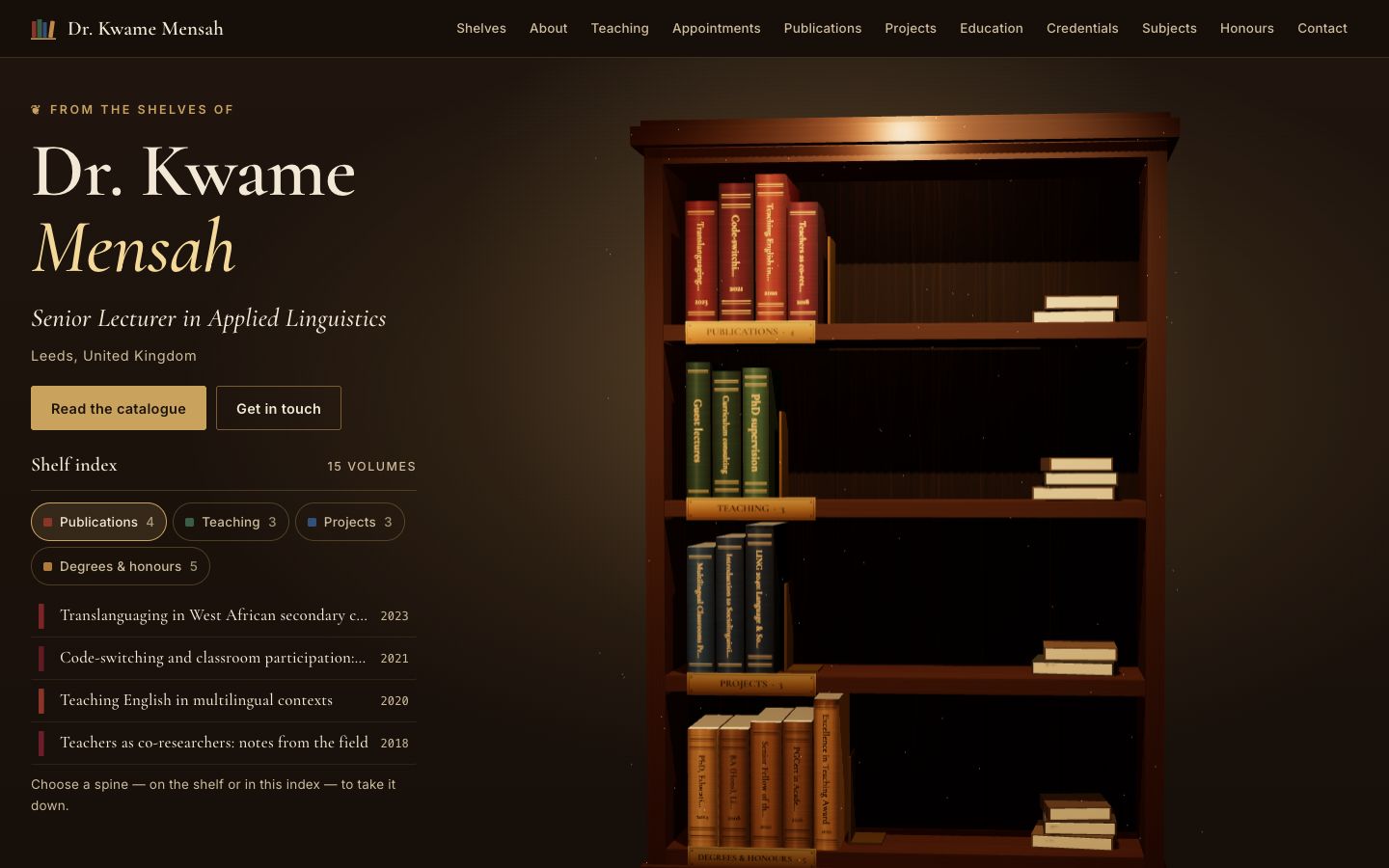
Stacks
A lamplit 3D bookcase: every spine is one of your publications, courses, projects or degrees — take one down to read it.
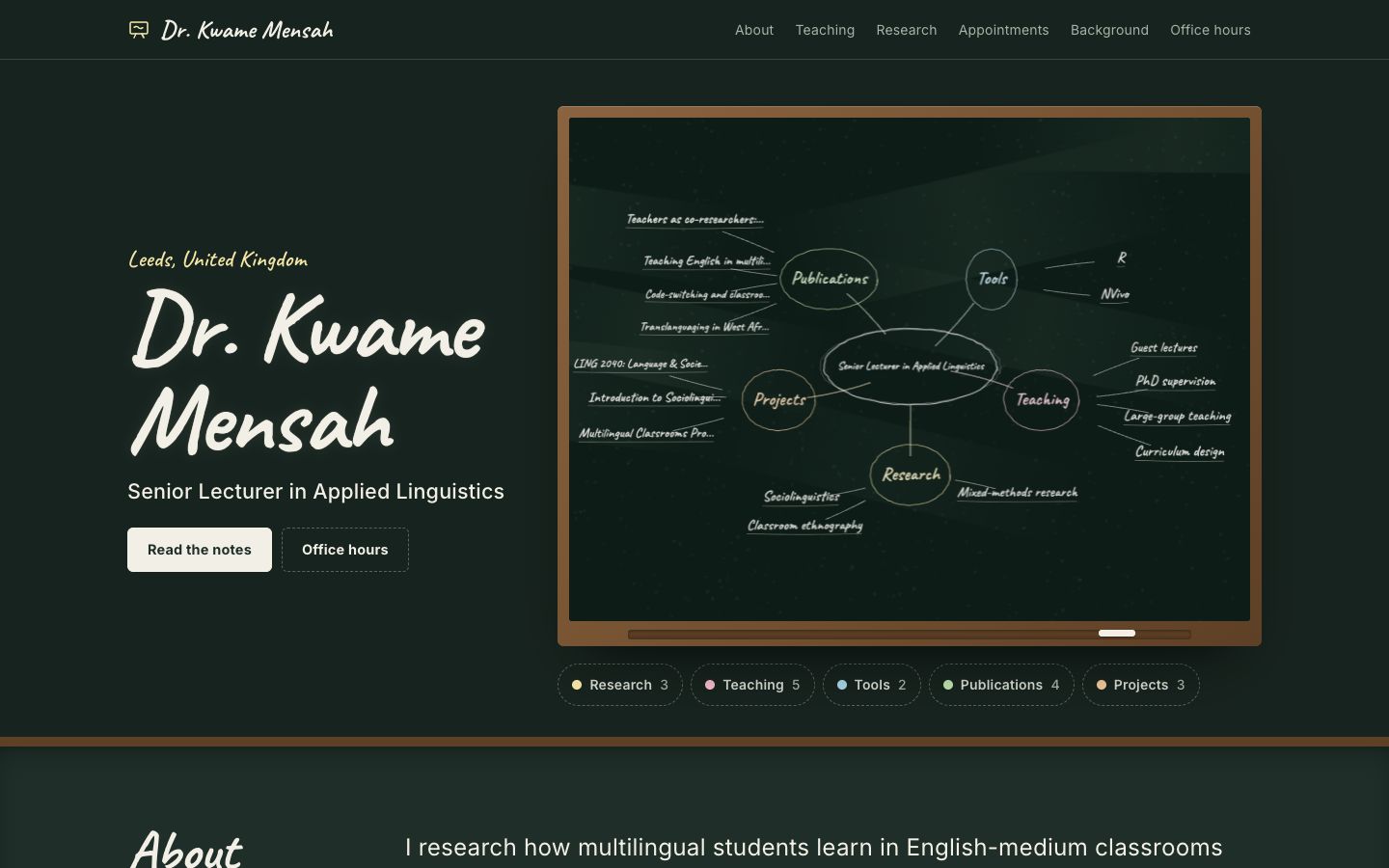
Chalkline
A framed chalkboard with a floating 3D chalk diagram of your subjects, teaching and publications.
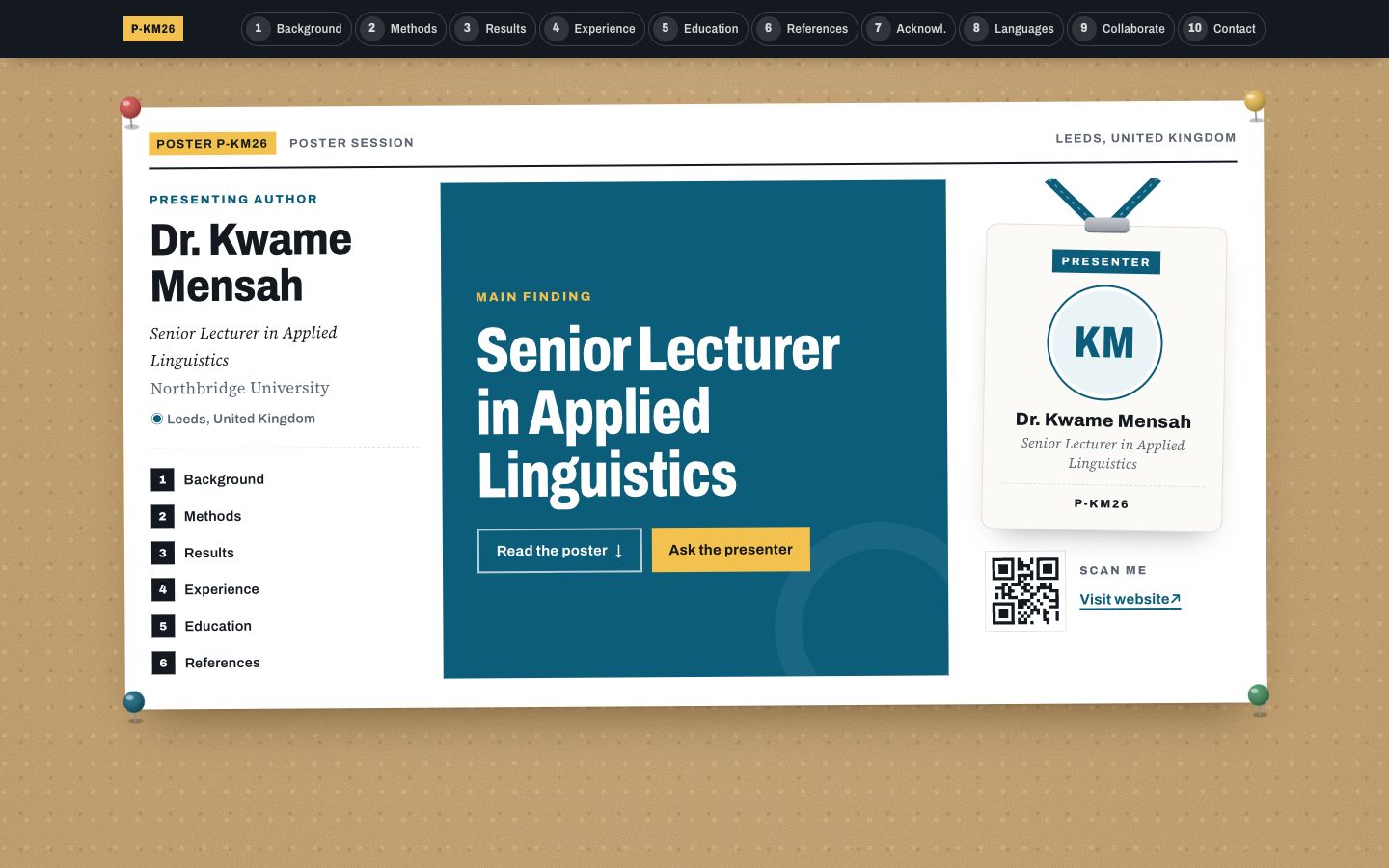
Poster Session
Your profile as a research conference poster: one big takeaway in the middle, methods-style columns around it and a scan-me corner.