Portfolio basics
Student portfolio: how to build one, with examples
How to build a student portfolio for internships and graduate roles from coursework, capstones, clubs and part-time jobs, with student portfolio examples.
By Numan Qamar, Founder, Folitox AI · · 8 min read
A student portfolio is a small website that shows employers what you can do while you're still studying. It's especially useful when you apply for internships, placements and graduate schemes, where every applicant has a similar degree and a similar resume or CV. The portfolio is where you get to be specific.
This guide is about the parts of a portfolio that are particular to being a student: turning coursework and capstone projects into strong examples, presenting clubs and part-time jobs, giving fair credit in group work, finding the right tone, and keeping the site current across your degree. If your main worry is that you have no work history at all, start with how to build a portfolio when you have no work experience, which covers choosing pieces and making the site look full. This guide picks up from there, and ends with a few illustrative student portfolio examples.
What internship and graduate recruiters look for
People hiring students aren't expecting finished professionals. They're looking for signs that you'll learn quickly and be useful early. In practice, that usually means:
- Evidence of real skills related to the role, even at a basic level.
- Initiative: things you did that nobody required.
- Follow-through: projects you finished.
- Working with others: group projects, teams, societies, jobs.
- Clear communication: whether you can explain your own work.
Recruiters for graduate schemes may read many applications for each place, so they often skim. Make the first screen of your portfolio answer three questions fast: what you're studying, what kind of role you want, and what you're proudest of.
A simple opening might read: "Third-year mechanical engineering student looking for a summer internship in product design or manufacturing. My capstone team built a low-cost prosthetic hand prototype; I led the mechanical design."
Turning coursework into student portfolio pieces
Most of your strongest material will come from your course. The challenge is that assignments are written for a marker who already knows the brief. A portfolio reader doesn't, so you need to supply the context.
Choose the right assignments
Look for coursework that:
- Is closest to the work you want to do after you graduate.
- Had an open brief, where you made real choices.
- Produced something you can show: a report, a design, code, a model, a presentation.
- Received good feedback, or that you've improved since.
A first-year assignment is rarely the best choice by your final year. Replace older work as newer, stronger pieces come along.
Rewrite, don't just upload
Uploading a marked PDF and calling it a project rarely works. Instead, write a short page for each piece:
- The brief, in plain language, in one or two sentences.
- Your approach and one or two decisions you made.
- What you produced, with images, excerpts or a link.
- The result: feedback, a grade if it's strong, or what you'd do differently.
You can still link the full report for anyone who wants it. For more on this structure, see how to write a case study.
Capstone and final-year projects
A capstone, dissertation, thesis or final-year project is usually the biggest thing you'll do as a student, and often the closest to real professional work. It deserves the top spot on your portfolio.
Give it more space than other pieces:
- The problem and why it mattered. If there was an industry partner or a real client, say so, within whatever confidentiality you agreed.
- Your role in the team, if there was one.
- The method, in terms a non-specialist can follow.
- The constraints: time, budget, equipment, data. Explaining how you worked within limits shows maturity.
- The outcome, including what didn't work.
- Visuals: photos of prototypes, diagrams, key charts or screenshots.
Before and after
Before:
"Final year project: Investigating energy efficiency in student housing. Grade: First."
After:
"For my final-year project, I worked with the university's estates team to find out why one student residence used noticeably more heating energy than others of a similar size. I installed temperature loggers in twelve rooms over six weeks, compared the readings with the building's heating schedule, and found that the heating ran at full output for several hours after most students had left for the day. I recommended a revised schedule, which the estates team trialled the following term. The project received a first-class mark."
The second version shows the real-world partner, a clear method, a finding and an outcome, all in one paragraph.
If your capstone was with an external partner, check what you're allowed to share before publishing. A short summary with the partner's name removed is usually safe; internal documents and data usually aren't.
Group projects and fair credit
Group work is everywhere in university, and employers like seeing it because most jobs involve teams. The risk is that "we did this" hides what you contributed.
Be specific about your part without minimising anyone else's:
- Name your role: "I was the team's data lead" or "I wrote the literature review and coordinated our meetings."
- Separate your work from the team's: "The team designed the survey together; I analysed the 140 responses and wrote the findings chapter."
- Credit others by role: "Our software was written by two teammates; I built the physical enclosure."
- Mention how you worked together, especially if you resolved a disagreement or kept the project on track.
Don't name classmates without asking, and never claim work that wasn't yours. Interviewers often ask follow-up questions about group projects, and it quickly becomes obvious who did what.
Clubs, volunteering and part-time jobs
Activities outside your course show things coursework can't: leadership, reliability, dealing with the public, managing money or time. Treat them as real experience.
A few student-specific examples of turning roles into evidence:
- Society treasurer: "Managed the society's annual budget, prepared termly reports for the students' union and introduced a simple expense form that cut reimbursement delays."
- Sports team captain: "Organised training for a squad of twenty and arranged travel for away fixtures."
- Campus job: "Worked twelve hours a week at the library help desk during term, answering questions from students and staff and training new starters."
- Volunteering: "Ran weekly coding sessions for secondary school pupils with two other volunteers, planning each session's activity."
Include roles unrelated to your field. A part-time retail job alongside a full degree says a lot about how you manage your time.
Academic tone versus professional tone
University trains you to write for markers: formal, thorough, heavily referenced, often in the passive voice. A portfolio needs something closer to a professional tone: clear, direct and short.
Some quick changes make a big difference:
- Use "I" for your own work instead of "it was found that."
- Lead with the finding, not the background.
- Cut academic hedging where it isn't needed, but keep honest limitations.
- Explain specialist terms or swap them for plain words.
- Shorten. A page summarising a forty-page report is a strength, not a loss.
Before: "This study sought to investigate the extent to which the implementation of a peer mentoring scheme may have had an impact on first-year retention."
After: "I looked at whether a peer mentoring scheme helped first-year students stay on their course."
Keep links to the full academic version for readers who want depth. For help with your introduction, see how to write a professional bio.
When to update your student portfolio
A student portfolio changes faster than most, because you're producing new work every term. A simple rhythm keeps it current without much effort:
- At the end of each term or semester, add your best new piece and remove the weakest.
- Before each application round, adjust your headline and opening to fit the roles you're targeting.
- After an internship or placement, add it as soon as you can, while the details are fresh, within whatever your employer allows you to share.
- When you graduate, change "student" to "graduate," update your goal and move education lower if you now have stronger professional examples.
Small, regular updates are much easier than a rushed rebuild the week an application is due.
Student portfolio examples
The outlines below are made up for illustration and don't describe real students or sites. They show how a portfolio for students can look different depending on the field and the role.
Example 1: an engineering student looking for an internship
- Opening: "Third-year mechanical engineering student looking for a summer internship in product design."
- Projects: the capstone prototype with photos and a clear note on their role, a CAD assignment rewritten as a short case study, and a robotics club build.
- Experience: a part-time workshop job and a society treasurer role, each with one concrete line.
Example 2: a business student applying for graduate roles
- Opening: "Final-year business student interested in operations and supply chain roles."
- Projects: a consulting-style group project for a local business, with their part separated from the team's; a dissertation summarized in plain language; a data analysis assignment with two key charts.
- Experience: a retail job, a placement year summary and volunteering as an event organizer.
Example 3: a design student applying for a placement
- Opening: "Second-year graphic design student looking for a placement in a branding studio."
- Projects: three studio briefs with sketches and final pieces, one self-initiated poster series, and a rebrand for a student society.
- Experience: freelance work for campus events and a short note on the tools they use.
If you already have a resume or CV, you can turn your resume or CV into a portfolio website with Folitox AI for free and then rewrite each project in your own words. The portfolio templates include simple layouts that suit a first portfolio.
Putting it together
A good student portfolio gives context that a resume can't. Lead with what you're studying and the role you want, put your capstone or strongest project first, and rewrite coursework so a stranger can understand it. Be clear about your part in group work, treat clubs and part-time jobs as real experience, and write in a direct, professional tone. Update it each term, and by the time you graduate it will already tell a clear story about what you can do.
Portfolio templates for Education & Teaching
These are Folitox templates designed for education & teaching portfolios, shown with sample content. Every one is filled in from your CV, and you can switch between them at any time.
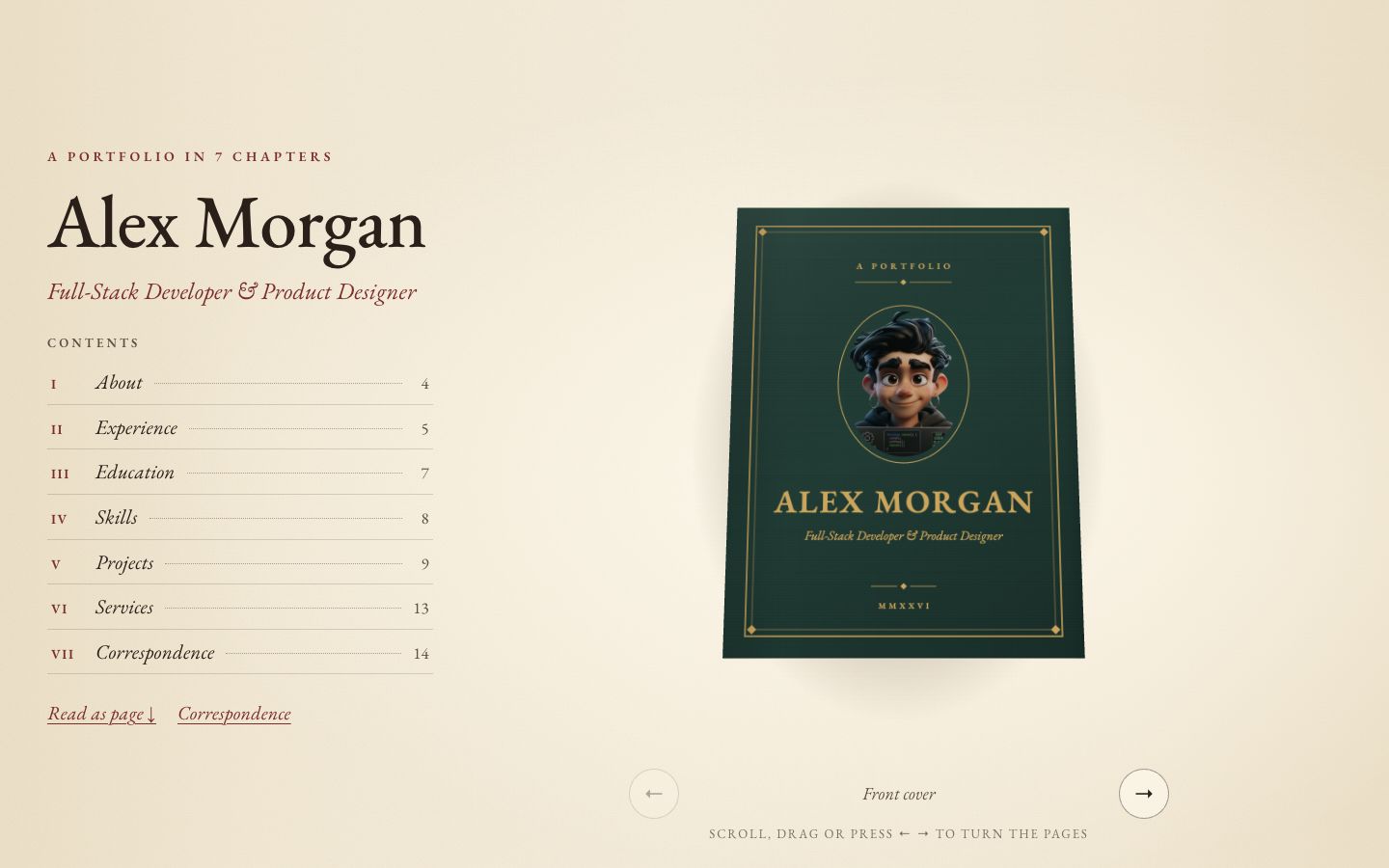
Chapter
Your story as a 3D hardcover on warm paper — scroll to turn curling pages, with a full reading view and letter-style contact form.
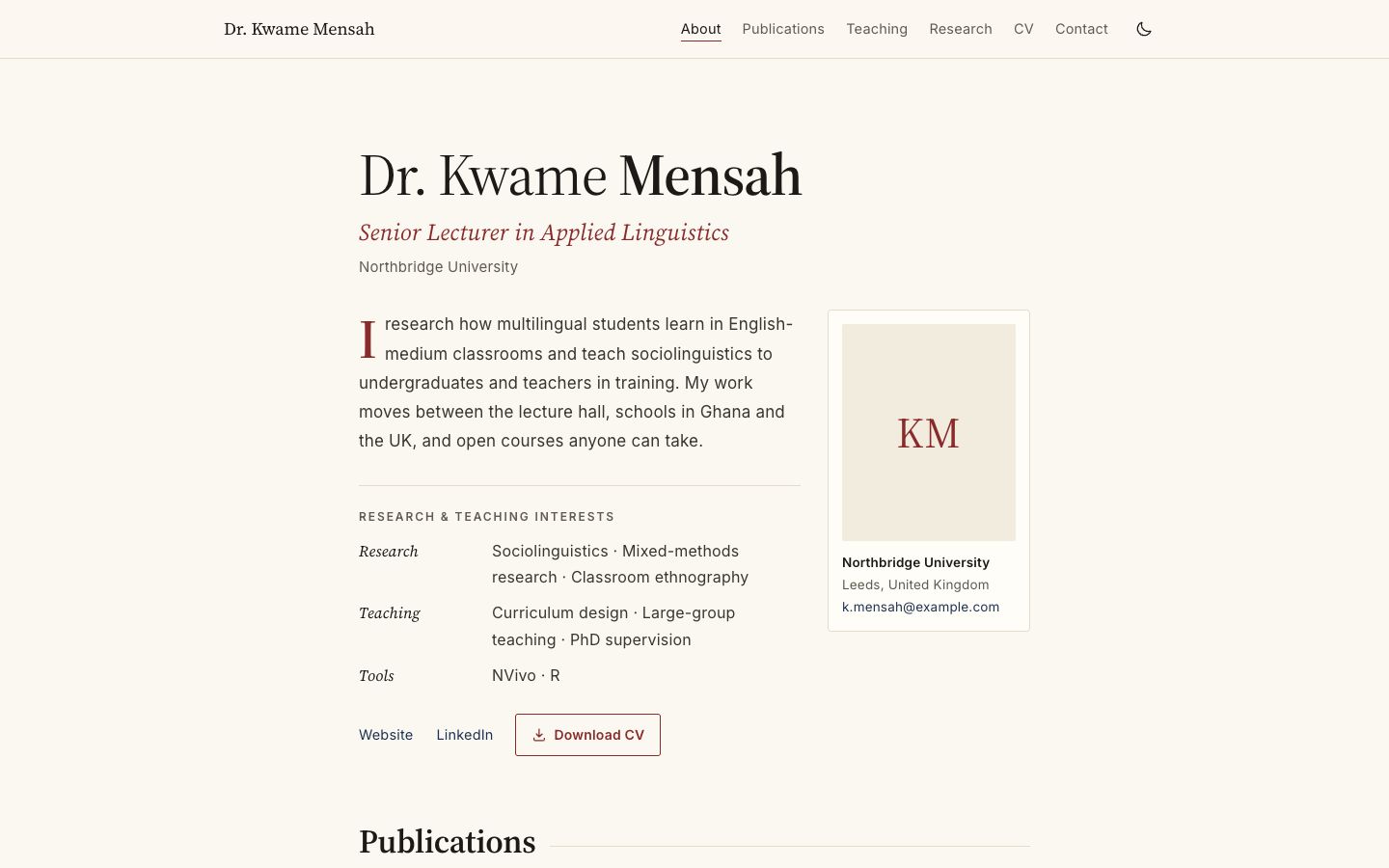
Academica
Scholarly single column: publications by year, teaching table, grants and talks.
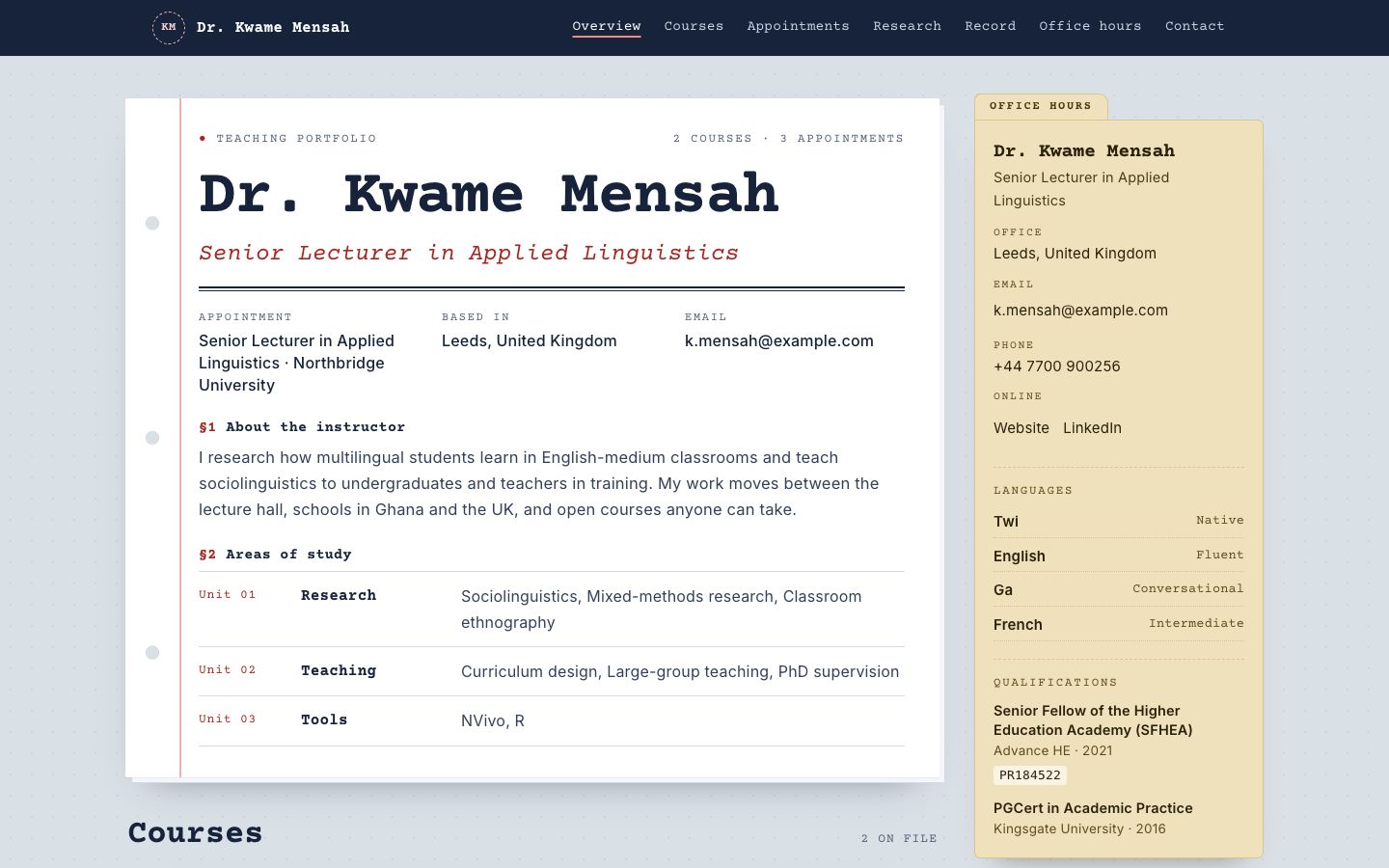
Syllabus
Courses as printed syllabus cards, with an office-hours sidebar and reading list.

Stacks
A lamplit 3D bookcase: every spine is one of your publications, courses, projects or degrees — take one down to read it.
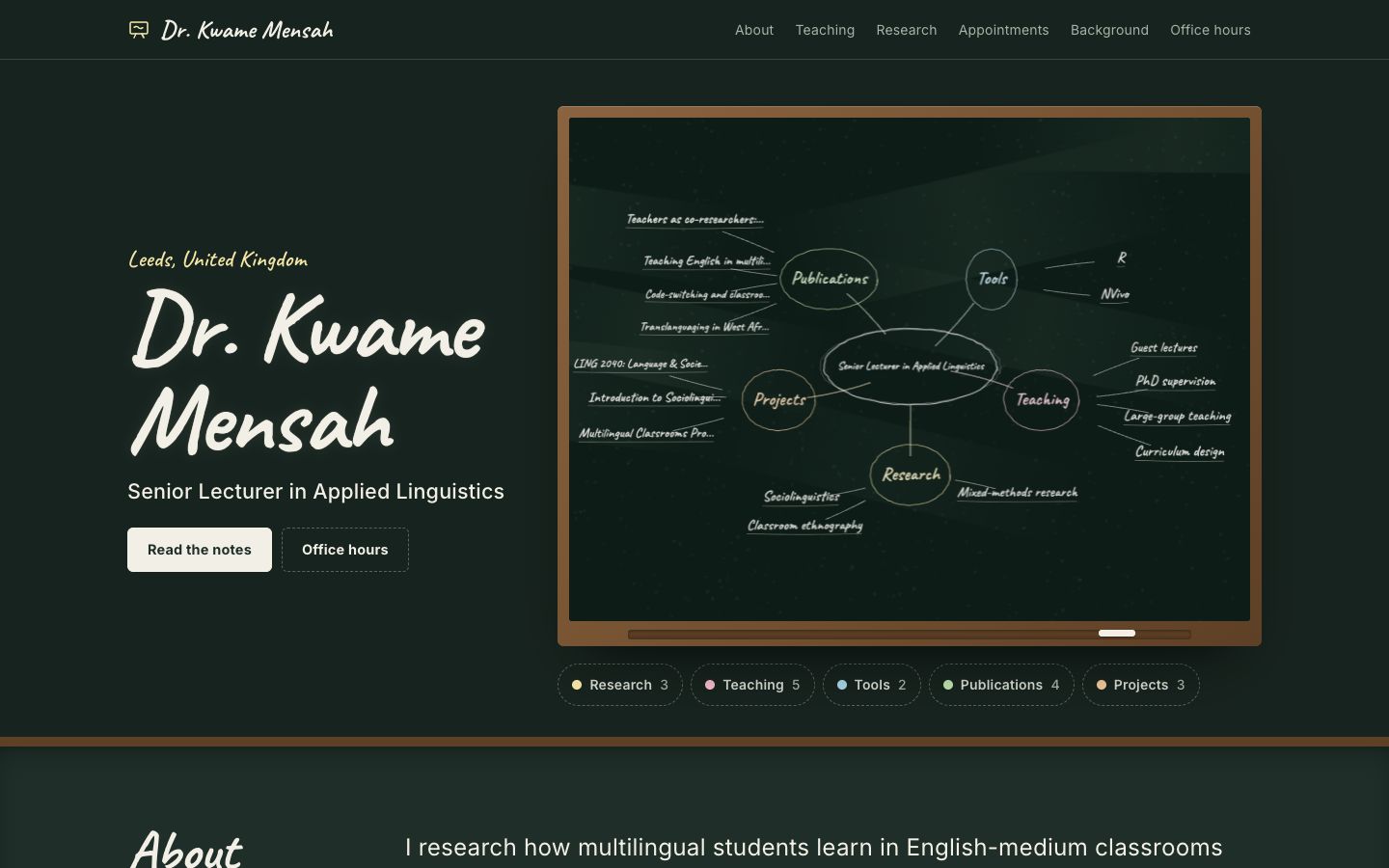
Chalkline
A framed chalkboard with a floating 3D chalk diagram of your subjects, teaching and publications.
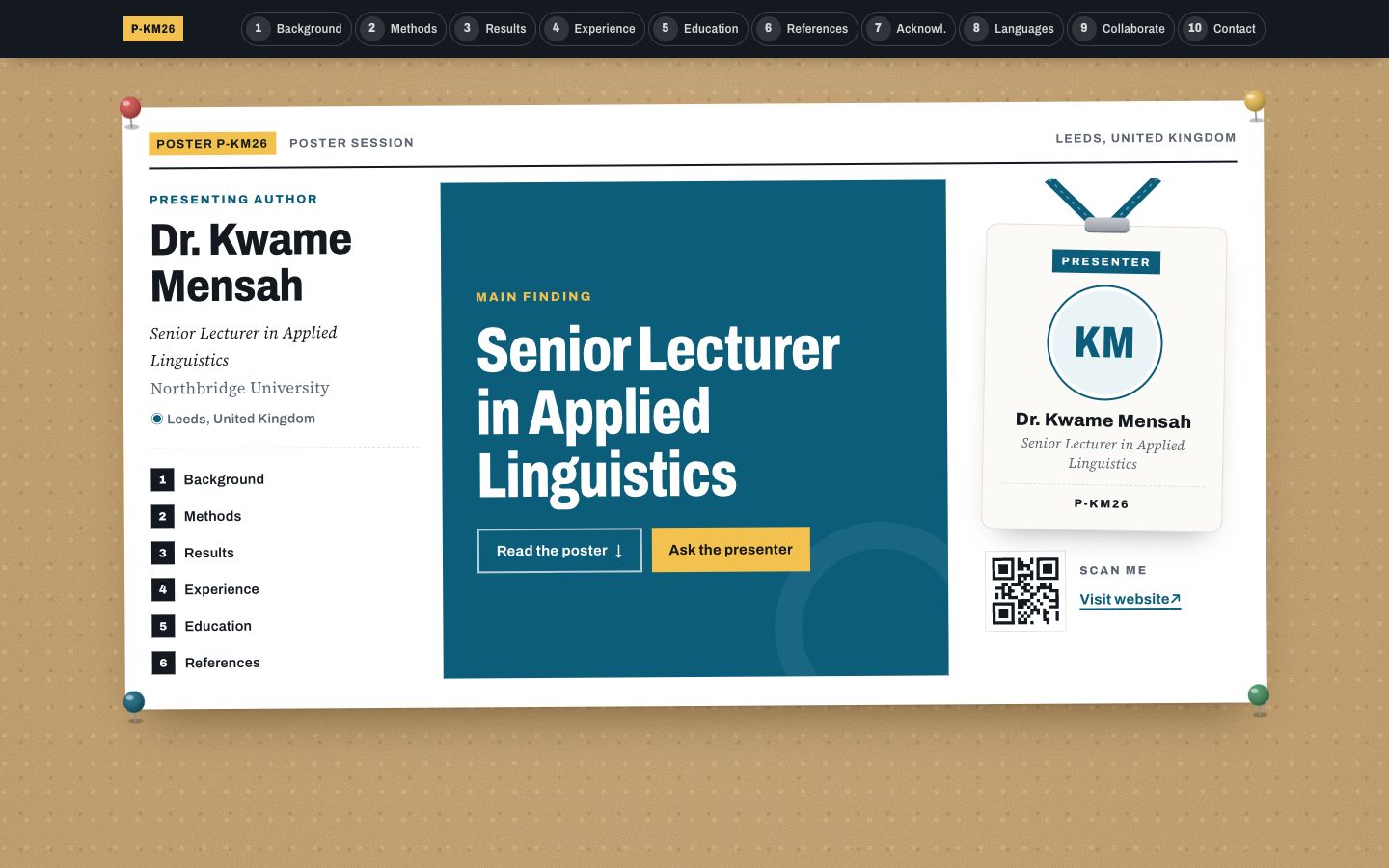
Poster Session
Your profile as a research conference poster: one big takeaway in the middle, methods-style columns around it and a scan-me corner.